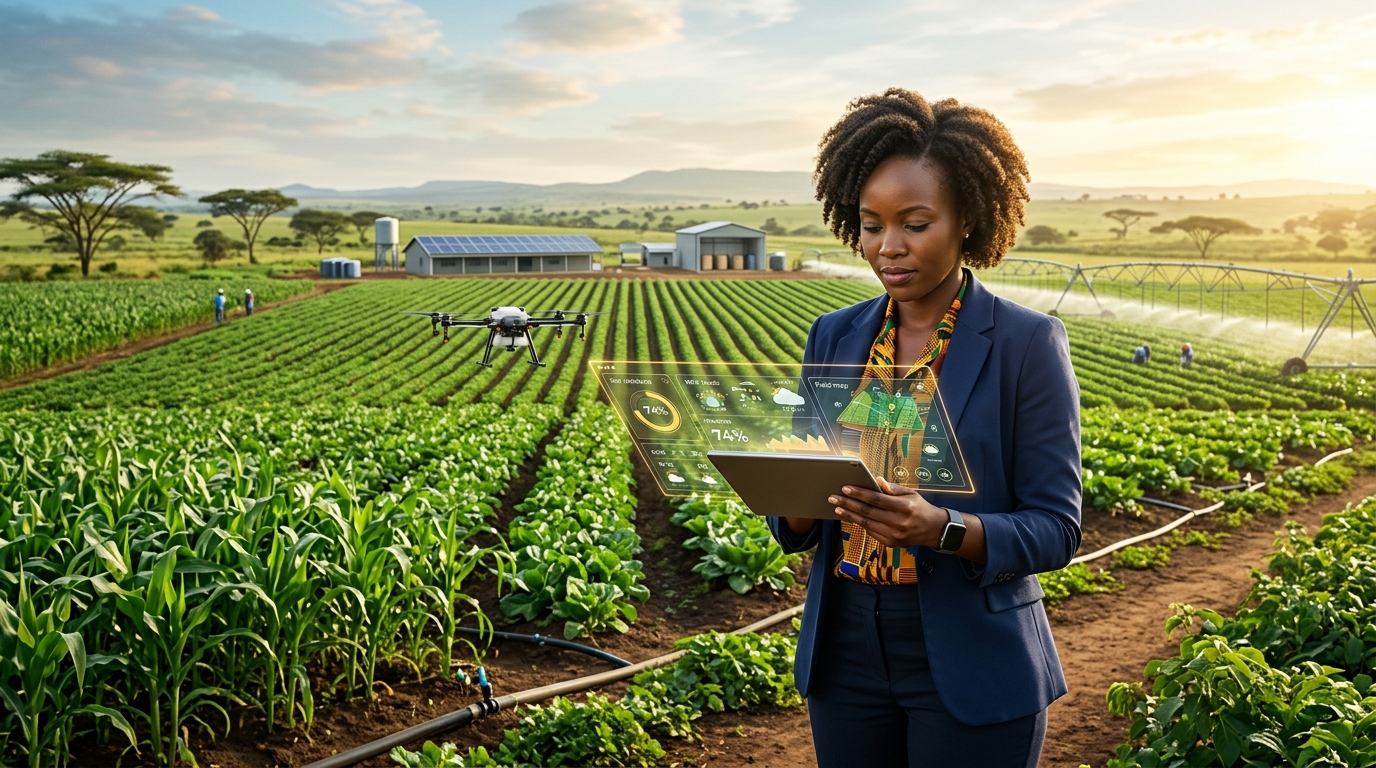
When industry commentators discuss the ongoing artificial intelligence revolution, the dialogue typically revolves around tech hubs, white-collar corporate automation, financial technology, and cutting-edge software development. In the context of the African continent, however, this narrow framing completely misses the mark.
To view technology literacy through a purely corporate lens is an expensive luxury. In Africa, where over 60% of the working population is directly or indirectly tied to agriculture, technology education is not just a career advancement tool, it is an economic lifeline, a foundational trade strategy, and a critical food security pillar.
The farm of tomorrow across East and West Africa is no longer being built exclusively with physical tools and seed varieties; it is being systematically engineered with data pipelines, machine learning models, and smart automation networks. Therefore, scaling tech education across local ecosystems is a profound economic priority.
1. The Agribusiness Paradigm Shift: Code, Climate, and Soil
Traditional agricultural practices across the continent are heavily vulnerable to climate volatility, unexpected pest outbreaks, and supply chain inefficiencies. When a farmer relies entirely on historical weather patterns that are changing due to global climate shifts, a single delayed rain cycle can wipe out an entire season’s yield, creating massive economic shocks and localized food supply deficits.
Practical AI intervention turns this unpredictable environment into a data-driven science:
Satellite-Powered Crop Monitoring and Remote Sensing
By leveraging machine learning models that analyze continuous satellite imagery and multi-spectral data, agribusinesses can monitor hundreds of hectares of land in real time. These AI systems can detect microscopic variations in crop health, tracking changes that are completely invisible to the naked human eye.
Predictive Environmental Modeling
Instead of guessing when to plant or harvest, localized AI tools analyze massive sets of historical and real-time atmospheric data. This allows them to predict exact rainfall patterns, project micro-climate shifts, and deliver highly localized, actionable insights directly to the hands of farmers and cooperative leads via accessible interfaces like WhatsApp Business or basic SMS channels.
Early-Stage Disease Detection
Advanced computer vision algorithms allow field operators to take simple photos of crop leaves using basic mobile devices. The AI instantly parses the image against vast agricultural datasets, identifies specific plant diseases or pest incursions before they can spread, and recommends precise, low-cost remediation strategies.
[ Raw Field Data ] ──► [ AI Computer Vision & Satellite Models ] ──► [ Actionable Insights ]
• Crop Imagery              • Disease Tracking & Classification            • Targeted Treatment
• Weather History           • Micro-Climate Predictive Analysis           • Ideal Planting Windows
• Soil Sensors              • Cross-Border Trade Supply Projections        • Optimized Logistics
2. Redefining Regional Trade and Supply Chain Efficiency
The benefits of deep AI literacy extend far beyond the physical boundaries of the farm. One of the greatest challenges facing African trade is logistics, specifically, post-harvest losses caused by broken cold chains, uncoordinated transport networks, and market information asymmetry.
When logistics coordinators and agribusiness operators are armed with strong tech and data literacy, they can design automated demand-prediction systems. These platforms calculate exactly when harvests will peak across different regions, match that data against live urban demand matrices, and dynamically route transportation networks to minimize waste.
By eliminating administrative friction and minimizing supply chain lag, local economies can reduce dependencies on expensive food imports, stabilize consumer pricing, and strengthen cross-border trade pipelines within regional economic zones.
3. Education as a Systemic Defense Mechanism
This is why building high-achieving tech cohorts and expanding practical technology training is so critical. If advanced technological education remains restricted to software developers in isolated metropolitan offices, the real economy will lag behind.
True innovation requires teaching technology in the context of the user’s immediate world. When we upskill an operations assistant, an accountant, or an agricultural cooperative manager, we are equipping them with the tools to build custom automation workflows, manage internal data assets, and deploy localized solutions that protect the economic integrity of our foundational industries.
Technology literacy is the definitive infrastructure of our survival. By empowering a new generation of technical builders, we ensure that our agricultural foundations are resilient, our supply chains are secure, and our economic future remains firmly in our own hands.