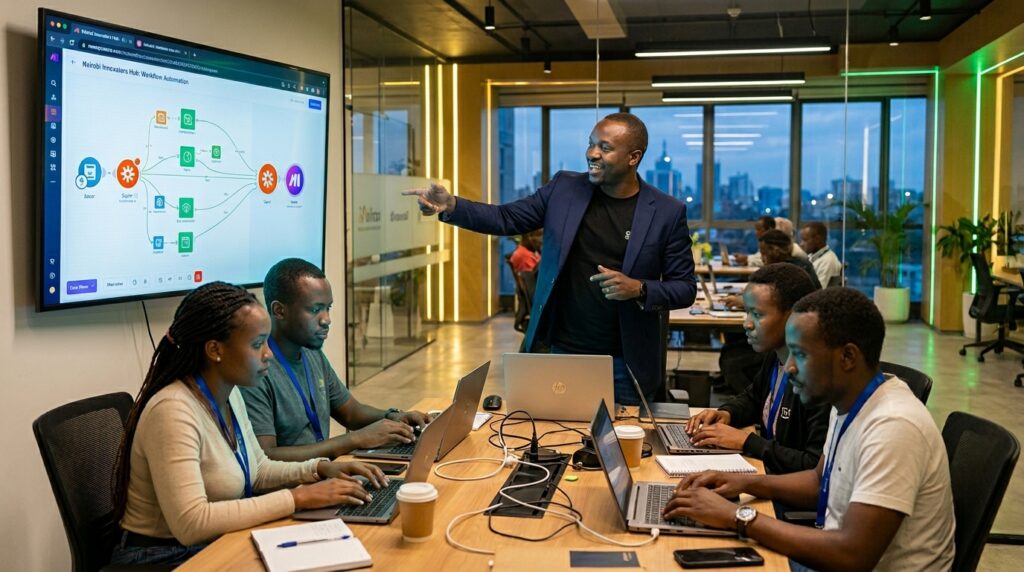
For decades, the narrative surrounding African intellect moving abroad was framed strictly around the concept of a “brain drain.” Highly skilled engineers, scientists, finance experts, and academic leaders left cities like Nairobi, Lagos, and Accra for the innovation hubs of Silicon Valley, London, and Washington, D.C. This migration was often seen as a direct loss to the local ecosystem’s development.
Today, a profound paradigm shift is underway. The historical “brain drain” is rapidly transforming into a dynamic, cyclical “brain gain.” This shift is fueled by a highly organized, tech-literate African diaspora that refuses to leave its heritage behind. Instead of permanently severing ties, diaspora professionals are actively building digital pipelines, investment networks, and strategic corporate channels back to the continent.
At the center of this transformation are highly structured, cross-border collaborative spaces, such as the prominent Kenya-USA Tech Forum (KUSAT) and its accompanying Diaspora Innovation & AI Conference (DIAC). These forums act as the ultimate translation layers, mapping international tech expertise, institutional capital, and advanced infrastructure directly onto the immediate, high-yield commercial opportunities evolving on the ground in Africa.
1. The Strategic Blueprint of Cross-Border Tech Contextualization
When high-level tech executives or engineers operate within developed market ecosystems, they gain deep exposure to bleeding-edge infrastructure, including sovereign cloud clusters, advanced machine learning architecture, and robust regulatory compliance models. However, when these concepts are exported back to Africa in a vacuum, they often fail.
The primary value of cross-border forums is contextualization. A diaspora software engineer working at an AI lab in Washington, D.C., understands the raw technical potential of advanced Large Language Models (LLMs). Simultaneously, an entrepreneur on the ground in East Africa understands the unique structural realities of local markets, such as the massive scale of informal retail networks or the dominance of mobile money payment systems like M-Pesa.
When these two forces meet in collaborative sandboxes, true innovation happens. The technology is stripped of its Western assumptions, allowing developers to build localized AI systems that natively account for multi-currency environments, regional language variations, and intermittent digital infrastructure.
       [ Diaspora Professionals ]               [ Local African Markets ]
     • Advanced Tech Infrastructure          • High-Scale Mobile Ecosystems
     • Institutional Capital Access          • Deep Contextual Market Needs
                    \                               /
                     \                             /
                      ▼                           ▼
                [ COLLABORATIVE CROSS-BORDER FORUMS (DIAC/KUSAT) ]
                                  |
                                  ▼
                [ LOCALIZED INTRAPRENEURSHIP & SCALE ]
2. Funneling Capital Beyond Traditional Venture Ecosystems
Historically, international venture capital pouring into African startups has been heavily concentrated within a few elite hubs and restricted to specific sectors, primarily consumer fintech. While vital, this narrow funding focus leaves major foundational sectors starved for institutional capital.
Cross-border tech forums completely rewrite this investment playbook by introducing a more diversified, emotionally invested investor class: the diaspora angel network.
-
The Power of Shared Identity: Diaspora investors possess an innate understanding of the markets they are funding. They do not look at an African city and see only political or macroeconomic risk; they see a hyper-energetic market full of unmapped demand.
-
De-risking Through Strategic Advisory: Beyond writing checks, diaspora professionals frequently step into advisory, judge, and moderator roles. This allows them to actively vet incoming pitches, conduct rigorous due diligence, and provide direct technical and corporate pathways for local startups to expand internationally.
-
B2B Corporate Pipelines: By operating within major global tech systems, the diaspora serves as a vital bridge for local African tech solutions to secure enterprise B2B contracts with international corporations, unlocking revenue streams that were previously entirely inaccessible.
3. Designing Sustainable Ecosystem Governance
The ultimate long-term impact of cross-border collaboration is the establishment of institutional infrastructure. Isolated individual mentorship programs, while noble, do not scale. True sustainability requires continuous talent pipelines and shared knowledge frameworks.
Through regular cross-border exchange programs, elite hackathons, and global technical advisory boards, international insights are systematically woven into local learning systems. Local tech cohorts gain access to global best practices, security protocols, and architecture reviews, ensuring that the applications built locally are stable enough to compete at an international grade.
The intelligent economy recognizes no geographical borders. As ecosystems continue to intertwine, the distinction between “local tech” and “global tech” fades, positioning Africa not merely as a consumer of global digital trends, but as a primary architect of its own technological future.